How to Build a Leadership Development Program that Scales
You run one leadership workshop, and it goes well. The feedback is warm, a few managers have lightbulb moments, and everyone leaves motivated. Three months later, nothing has changed. The lessons faded, the momentum died, and you are back where you started. Or the opposite happens. It goes so well that everyone wants it, and you realize the version you built by hand for 12 people will not survive delivery to 200 across five locations or to a new client every quarter.
This guide walks you through creating a leadership development program that holds up as you grow, whether you are developing your own managers or delivering leadership training to clients.
- What is leadership development?
- What is a leadership development program?
- Why most leadership development programs don t scale
- The framework: 6 steps to build a leadership development program
- How to develop leadership skills at every level
- Making the program repeatable across teams and clients
- Leadership development training vs. coaching: what to use when
- Build your leadership development program with Easy LMS
Table of contents
- What is leadership development?
- What is a leadership development program?
- Why most leadership development programs don t scale
- The framework: 6 steps to build a leadership development program
- How to develop leadership skills at every level
- Making the program repeatable across teams and clients
- Leadership development training vs. coaching: what to use when
- Build your leadership development program with Easy LMS
What is leadership development?
Leadership development is the ongoing process of building the skills, behaviors, and judgment people need to lead others well
Before you build a program, it helps to be clear on what you are actually developing. Leadership is not a fixed trait that people either have or lack; it can be taught, practiced, and improved like any other capability.
Leadership development is the ongoing process of building the skills, behaviors, and judgment people need to lead others well. It covers everything from a first-time team lead learning to delegate to a senior manager learning to set direction across departments. The keyword is ongoing. A single course can spark change, but leadership grows through repetition, feedback, and real situations over time.
That distinction matters because it shapes everything that follows. You are not designing one event. You are designing a system that keeps developing people long after the first session ends.
What is a leadership development program?
A leadership development program is the structured, repeatable system you use to deliver growth. It defines the outcomes you are aiming for, the learning methods you will use, the path people follow as they move up through levels of responsibility, and the way you measure whether any of it worked. In practice, it can combine courses, coaching, mentoring, assessments, and on-the-job practice into one coherent path rather than a scatter of disconnected activities.
For many organizations, that program serves their own managers. For consultancies, training providers, and franchises, the program is something they deliver to clients, from one client to the next, or from one location to the next. Both are leadership development programs. The difference is that the second kind has to survive being repeated, which is exactly where most programs start to crack.
Why most leadership development programs don't scale
Plenty of programs work the first time beautifully and fall apart the second. The content is usually good, but it was never built to be repeated. When you understand why they break, you can design around it from the start.
Here are the failure points that show up again and again once a program grows beyond its first group:
It was built for one specific group. The content assumed a particular team, industry, or set of examples, so it does not travel to the next audience without a rebuild.
It leans on one person. The whole thing works because one talented facilitator is in the room. Remove them or try to run three sessions at once, and the quality drops.
The material lives in someone's head. Or on a laptop, or in a slide deck that only its creator understands. Nothing is documented in a way that another trainer can pick up and deliver consistently.
There is no consistent measurement. Every group is assessed differently, or not at all, so you cannot prove the program worked. That is an internal problem and a dealbreaker when a client asks for results.
Every new client or location means starting over. Without a reusable structure, growth multiplies your workload.
But none of these are inevitable, as each is a design choice, and the framework below is built to avoid all five.
Centralize, simplify, and scale your training with Easy LMS!
Book a demo
Save time on admin, spend time on high-impact tasks
Our academy automates tasks like invites, certificates, and reports. Freeing up your time for what matters most!

Scale your training services effortlessly
Train multiple customers simultaneously without breaking the bank or drowning in repetitive administrative tasks.

Keep costs low
Our pricing is simple, predictable, and scalable. No per-participant fees, making it cost-effective. Plus, everything is online for you and your clients, saving you more money!
The framework: 6 steps to build a leadership development program
A strong program is a sequence of deliberate decisions, each one building on the last. Work through these six steps in order, and you will end up with a program that has a clear purpose, fits the people it serves, and can be delivered again without falling apart.
Step 1: Define the business outcome you're solving
Every effective program starts with a problem worth solving, not a topic worth teaching. If you cannot name the outcome you are chasing, you cannot tell whether the program succeeded.
Managers have an outsized effect on the teams they lead. This means the quality of your leaders shapes retention, productivity, and morale more than almost anything else you can influence. So the outcome is rarely 'teach leadership.' It is something concrete: reduce turnover on the shop floor, get new managers productive faster, prepare regional leads to run their own locations, or cut the support tickets caused by teams that were never trained properly.
Write the outcome down before you design a single lesson. It becomes the test that every subsequent decision must pass.
Step 2: Assess current leadership skill gaps
Once you know where you are going, you need an honest picture of where people are starting from. Skipping this step is how programs end up teaching things people already know while ignoring the gaps that hold them back.
Assessment can take many forms: self-assessments, manager reviews, 360-degree feedback, short skills audits, or simply observing how people handle real situations. The aim is to identify the difference between the leadership behavior you need and the behavior you have today, so your program targets the gap rather than guessing at it.
If you deliver training to clients, this step is also your strongest sales tool. Auditing a client's teams before you propose content shows them exactly where the gaps are, which makes the program you recommend feel necessary rather than optional. The assessment does double duty: it sharpens the program, and it justifies it.
Step 3: Choose the right learning methods
With the gaps mapped, you now have to decide how people will learn. This is also the first point where scale enters the picture, because some methods travel and some do not.
Most strong programs blend a few approaches:
Self-paced online courses for foundational knowledge everyone needs, delivered consistently, no matter how many people take them.
Live sessions for discussion, role-play, and the kind of learning that benefits from a group.
Coaching and mentoring for personalized guidance on individual challenges.
On-the-job practice through stretch assignments and real responsibility, where leadership actually sticks.
Here is the scale test to apply to each one: what happens when you need to run this for the tenth group, or for three clients at once? A method that relies on a single expert in a single room does not scale. Reusable content obviously does. The more of the foundational material you can build once and deliver many times, the more the live, high-touch elements can go where they add the most value.
Step 4: Design for different leadership levels
A new team lead and a senior manager need different things, and a program that treats them the same serves neither well. Designing distinct paths for different levels turns a generic course into a program people grow through.
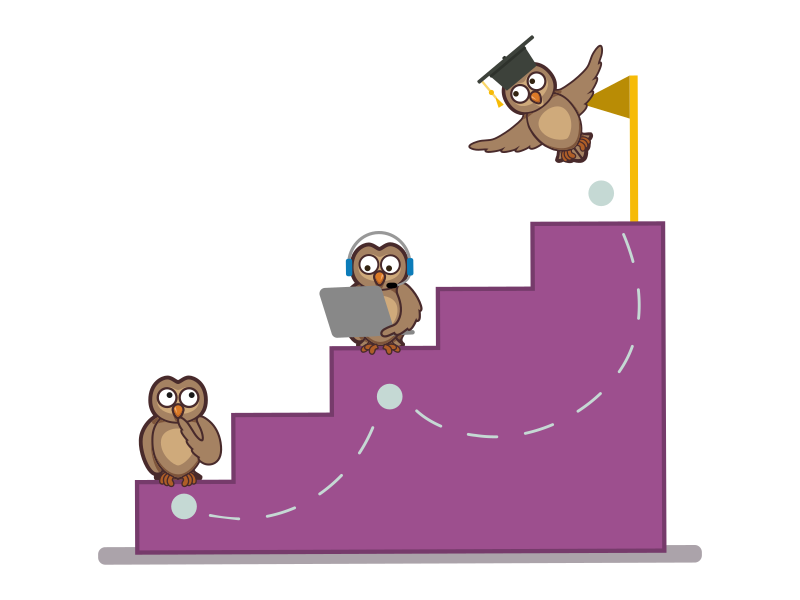
Most programs work across three broad levels: emerging leaders stepping into their first management role, established managers leading larger or more complex teams, and senior leaders setting direction across the organization. Each level builds on the one below it.
To make that concrete, here is a simple skeleton for the first level, a new team lead:
Outcome: confident, capable in the first 90 days.
Core skills: delegation, giving feedback, running one-on-ones, basic conflict resolution.
Methods: self-paced onboarding course, a peer cohort, and on-the-job practice.
Practice: lead one small project end-to-end.
Success measure: completes the course, receives positive feedback from their team, and holds regular one-on-ones.
You can build the same skeleton for every level, which gives you a second advantage. When the structure is standardized, the same framework works across teams, clients, and locations. You are not reinventing the program each time; you are dropping a known structure into a new context.
That repeatable structure is what carries you into real scale.
Step 5: Build in coaching and peer accountability
Knowledge fades fast when no one is expected to use it. The programs that change behavior are the ones that keep people accountable after the learning ends, and that rarely happens by accident.
Coaching gives people someone to think through real challenges with, turning abstract lessons into decisions they actually make at work. Peer accountability does something coaching cannot: it creates a group of people going through the same growth at the same time, comparing notes and keeping each other honest. A new manager’s cohort that checks in monthly will outlast any workshop because the pressure to show up and make progress comes from peers rather than a certificate.
Build these in from the start.
Step 6: Measure impact and iterate
A program you cannot measure is a program you cannot improve, or even prove. This final step closes the loop back to the outcome you defined in step one and keeps the whole thing honest.
Measure at two levels:
First, the learning itself: completion rates, assessment scores, and which topics people struggle with, so you can see where the content needs work.
Second, the outcome: did turnover drop, did new managers ramp up faster, did the problem you set out to solve actually move?
The first tells you if the program ran well, while the second tells you if it mattered. This is also where delivering to clients raises the bar. A client, franchisee, or regional manager will want to see results on demand, not wait for a quarterly summary. Being able to show completion and pass rates for each group at any time turns your reporting from an afterthought into a reason to renew. Measure consistently, review often, and treat the program as something you refine rather than something you finish.
How to develop leadership skills at every level
The framework gives you the structure. This is where you fill it in with the specific skills each kind of leader needs to develop, because 'leadership skills' mean something different depending on who you are developing.
New managers and team leads
This group needs the fundamentals of leading people for the first time: delegating instead of doing everything themselves, giving feedback that lands, running useful one-on-ones, and handling small conflicts before they grow. The jump from doing the work to leading the people who do it is the hardest transition most leaders ever make, and it deserves the most support.
Established managers
This group needs to lead through others rather than directly. That means prioritizing across competing demands, developing the people beneath them, communicating with stakeholders above them, and sometimes making decisions with incomplete information.
Multi-location and franchise managers
This group carries an extra load: keeping standards consistent across places they cannot always see. They need to lead teams they do not sit with, uphold brand or operational standards, and spot problems through reports rather than in person. Consistency is a skill, and it is a genuinely different one.
Match the skills to the level, and each group gets development that fits where they are. That fit is what keeps people engaged long enough to grow.
Making the program repeatable across teams and clients
Everything so far has pointed here. A program that changes one team is good work. A program you can deliver again and again to new teams, new locations, or new clients, without rebuilding it each time, is a genuine asset. This is where design choices turn into leverage.
A few principles that make a program repeatable:
Build content once, reuse it everywhere. Foundational courses and assessments should be created once and delivered many times, so growth stops meaning more work.
Keep groups cleanly separated. Every team, client, or location needs its own space, its own participants, and its own results, without its data bleeding into others.
Give each audience its own front door. A branded, dedicated environment per client or location makes the program feel tailored, even when the underlying structure is shared.
Make reporting self-serve. When clients and managers can pull their own completion and pass rates at any time, you spend less time reporting, and they trust the program more.
Certify completion. A certificate at the end proves the training happened, which matters for audits, compliance, and simply showing a client their people did the work.
Put these together, and your program starts being scalable.
Leadership development training vs. coaching: what to use when
Training and coaching often get treated as rivals when they are really two tools for two different jobs. Knowing which one to reach for saves you money and gets people better results.
Training is how you consistently deliver knowledge and skills to many people. It shines when there is a defined body of content everyone needs, when you are onboarding new leaders at scale, or when consistency across a group matters more than personalization. It is efficient, repeatable, and measurable, which is why it forms the backbone of most programs.
Coaching is how you develop one person through their specific challenges. It shines when someone is facing a situation no course anticipated, when a senior leader needs a confidential thinking partner, or when the gap is about judgment and behavior rather than knowledge. It is high-touch, personal, and harder to scale, which is why it works best focused where it matters most.
The strongest programs use both. Train the fundamentals broadly so everyone shares a baseline, then apply coaching selectively where individual growth needs a human touch. So use training to scale, and coaching to deepen.
Build your leadership development program with Easy LMS
Once your program is designed, you need somewhere to run it that can grow with you. This is where Easy LMS fits, because it was built for exactly the kind of repeatable, multi-group delivery that leadership development at scale demands.
You can build your courses and exams once and reuse them across all teams, clients, or locations without rebuilding. Each client or franchise gets its own branded academy, keeping groups cleanly separated while sharing the same underlying content. Your reports show completion and pass rates in real time, which means clients and managers can access their results on demand rather than waiting on you. Certificates are handled automatically, and because pricing is a flat fee rather than per participant, your costs stay predictable no matter how many people you train.
In other words, the principles that make a program repeatable are the ones Easy LMS is designed around. If you are ready to deliver leadership development that scales, you can start a free trial and build your first program.
What are examples of leadership development?
Leadership development takes many forms, and most programs combine several of them. Common examples include structured online courses on core management skills, mentoring pairings between junior and senior leaders, coaching for individual challenges, stretch assignments that give people real responsibility, 360-degree feedback exercises, and cohort programs where a group of new managers grows together. The best example is usually a mix, matched to the level and the outcome you are aiming for.
What are some effective leadership development goals?
Effective goals are specific and tied to a real outcome rather than a vague ambition to ‘be a better leader.’ Strong examples include holding consistent weekly one-on-ones with every team member, delegating a defined set of responsibilities within 90 days, improving a team engagement or feedback score by a set amount, successfully leading one cross-functional project, or coaching a direct report toward their own promotion. A good goal is measurable, time-bound, and connected to how the person leads.
How can I develop my leadership potential?
Start by getting an honest read on where you stand from feedback from the people around you, rather than relying on self-assessment alone. Then pick one or two specific skills to work on rather than trying to improve everything at once. Seek out real responsibility, because leadership grows through practice more than through reading, and find a mentor or coach who can help you reflect on what is working. Consistency matters more than intensity. Small, repeated efforts compound.
How do I improve my effectiveness as a leader?
The fastest route is usually to ask your team what would help, then act on it visibly. Beyond that, focus on the fundamentals that most affect a team: communicate clearly and often, give feedback that is timely and specific, make decisions without unnecessary delay, and develop the people you lead rather than doing their work for them. Measure yourself the same way you would measure a program, by looking at whether your team's engagement, output, and growth are moving.
